Part IV examined the roles of tyres, roads and wide loads to the carnage on Ghana roads.
This part aims to consider the contributions of speed ramps, motorways, and warning signs to the carnage on our roads.
Most of the ‘death traps’ on our roads, mistakenly referred to as speed ramps are nothing other than ‘instruments of road user killers’. A majority of these so-called speed ramps have no warning signs at all. In the few instances that there are warning signs, the signs are usually placed right beside the speed ramp, thus defeating their purpose.
Imagine driving at say, 90 Kms per hour (equivalent to about 56 miles per hour) between Assin Fosu and Fomena or between Kintampo and Buipe, and out of nowhere, a killer speed bump is displayed like magic in front of you.
No wonder there are reports of road traffic accidents and needless loss of lives almost every day in Ghana.
In Ghana, one must be familiar with a particular road before you can drive on it. Most often, there are no directional signs to guide motorists. Just drive into Kumasi and see whether there are directional signs to guide you safely to the Offinso – Techiman – Kintampo Highway.
Why should one even drive through Kumasi on the way up north if the motorist has no business in Kumasi?
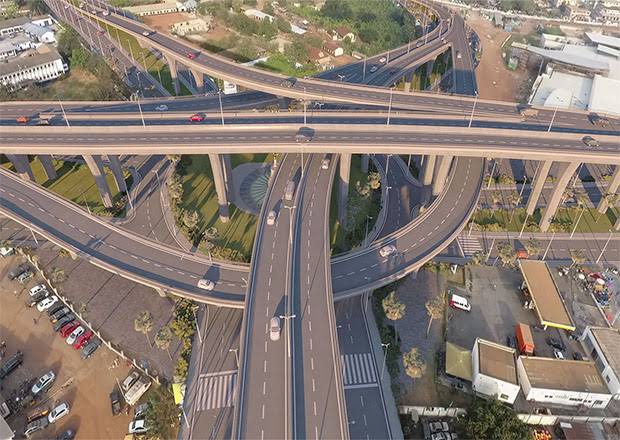
The construction of motorways that bypass congested inner-city roads like Kumasi is the way out. Anytime I drive through Kumasi, either to or from the north, I waste close to two (2) hours plus fuel navigating through a congested area that shouldn’t have formed part of my route if we had constructed motorways across this country.
For instance, a motorist traveling from London to Birmingham will have a minimum of three (3) motorways to choose from (M1, M11 and M40), and none of these motorways passes through a city or town. There are no traffic lights and no roundabouts on the motorways. Also prohibited on UK motorways are pedestrians, cyclists, and motorcyclists with provisional licenses (learner license). As for police/immigration/customs barriers, there is none on any UK road.
Very soon, the Ghana National Fire Service and Prisons Service will follow the footsteps of the Ghana Immigration Service and also mount barriers on our roads for the purposes of apprehending those who place hoax calls to the Fire Service and escaped convicts respectively.
Do we have any regulations governing the use of the Accra – Tema motorway? Absolutely none! If we had any regulations governing the use of that motorway or any other road in this country, tricycles (aboboya) wouldn’t be crawling on our roads and inviting fast moving vehicles to come and run over them.
The variety of routes available to choose from to one’s destination in the UK, leads to less congestion on the roads, thus resulting in infrequent accidents.
There is no motorway from Accra to Kumasi, and there appears to be only one route from Accra to Kumasi, and that’s the Accra – Nsawam – Nkawkaw single carriageway, which is notorious for head on collisions arising out of negligent and inconsiderate overtaking.
From London to Birmingham is about 120 miles (200 Kms). Driving at 70 miles per hour, which is about 113 Kms per hour (the national speed limit for cars in the UK), it will take a motorist driving at the national speed limit, just under two (2) hours to reach his destination.
From Accra to Kumasi is about 155 miles, and it will take a motorist about five (5) hours to cover that distance. Clearly, the lack of motorways is costing Ghana a lot in terms of man hours, fuel and lives. With motorways being typically three-lane roads in both directions, the possibility of a head on collision is reduced to the barest minimum.
Revisiting the speed ramps, most of them are very huge like mountains, constructed poorly right in the middle of the road.
Just attempt driving one of the latest saloon Honda or Mercedes Benz cars from Mankessim through Assin Fosu to Kumasi or from Kumasi to Tamale, and you will get a true picture of my concern here. This calibre of cars cannot safely go over these mountain-like speed ramps in a straight line; hence, drivers of such cars always snake over these unreasonable speed ramps, thus endangering their lives and the lives of other road users.
In the UK, any stranger can drive virtually to any part of the country without the need for assistance from anyone. In all cases, speed ramps signs are posted a mile or half a mile to the ramps; with additional countdown markers like 300 yards, 200 yards and 100 yards. Furthermore, the speed ramps are not deadly like the case of Ghana.
In respect of directional signs, at most intersections in the UK, there are at least three (3) directional signs to guide motorists; thus, gantries, sign boards and physical markings on the road. A gantry is a traffic sign assembly where signs are mounted on an overhead support to provide clear road signs to motorists. Most gantries also contain an apparatus for traffic monitoring systems and cameras. They are also used in open road tolling.
In Ghana, cheap paint is most often used for the writing of signs on the road, which easily fades away. The few sign boards positioned by the roadside to help motorists navigate safely to their destinations are most often stolen by some unscrupulous scrap dealers who care less about their own lives and the lives of others.
Part VI loading……
Alhassan Salifu Bawah
(son of an upright peasant farmer)
Discover more from Hot Stories Ghana
Subscribe to get the latest posts sent to your email.